Divorce vs Judicial Separation: What Is the Difference and Which Option Is Right for You?
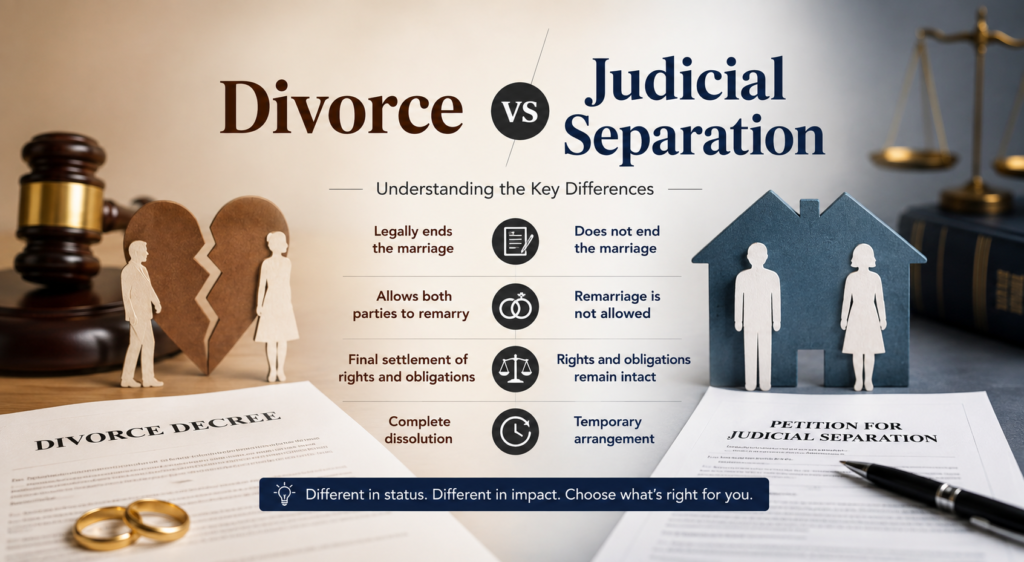
When a marriage is facing serious difficulties, couples may consider legal remedies such as divorce or judicial separation. Although both can provide spouses with legal relief from living together, they are not the same. The biggest difference is that divorce legally ends the marriage, while judicial separation does not dissolve the marriage.
Understanding the difference between divorce and judicial separation can help spouses make a more informed decision about their legal options.
For individuals looking for guidance on divorce, judicial separation, family disputes, or matrimonial matters in Hyderabad, consulting an experienced family lawyer can help clarify the legal process and available remedies. i9 Legal provides legal assistance for individuals dealing with matrimonial and family-law matters.
What Is Judicial Separation?
Judicial separation is a legal remedy through which a court formally permits spouses to live separately without dissolving their marriage.
Under Section 10 of the Hindu Marriage Act, 1955, either spouse may seek a decree of judicial separation on grounds specified under Section 13 and, where applicable, additional grounds available to a wife under Section 13(2). Once a decree is granted, the petitioner is no longer legally obligated to cohabit with the other spouse.
In simple terms:
Judicial separation means “we are legally allowed to live apart, but we are still married.”
It can provide spouses with an opportunity to live independently while leaving open the possibility of reconciliation.
What Is Divorce?
Divorce is the legal dissolution of a marriage through a court decree. Once a divorce decree becomes final, the marital relationship is legally terminated, subject to applicable law and appeal rights.
Under the Hindu Marriage Act, Section 13 provides grounds on which a marriage may be dissolved by divorce. These include grounds such as cruelty, adultery and desertion, among others specified by the Act.
For example, in a mutual-consent divorce under Section 13B, both spouses may jointly seek dissolution of the marriage after satisfying the statutory requirements.
In simple terms:
Divorce means “the marriage is legally ended.”
Divorce vs Judicial Separation: Key Differences
| Factor | Judicial Separation | Divorce |
|---|---|---|
| Status of marriage | Marriage continues | Marriage is dissolved |
| Living together | Spouses are not required to cohabit after the decree | Marriage has ended |
| Possibility of reconciliation | Marriage can continue and reconciliation is possible | Marriage is legally terminated |
| Right to remarry | Generally, spouses cannot remarry because the existing marriage continues | A divorced person may remarry subject to applicable law and finality of the decree |
| Purpose | Legal separation without ending the marriage | Permanent dissolution of marriage |
| Legal relationship | Husband and wife remain legally married | Husband and wife cease to have the marital status after dissolution |
| Future step | May potentially lead to reconciliation or later divorce | Ends the marital relationship |
Divorce vs Judicial Separation: Which Is Better?
There is no single answer because the appropriate remedy depends on the circumstances of the marriage.
Judicial separation may be considered when:
- The spouses need time apart.
- The parties are not ready to permanently end the marriage.
- There may still be a possibility of reconciliation.
- Living together has become difficult but divorce is not yet the preferred option.
- One or both spouses want a formal legal arrangement allowing them to live separately.
Judicial separation can therefore act as a legal middle ground between continuing the marriage normally and ending it completely.
Divorce may be considered when:
- The marriage has irretrievably broken down in the practical sense and applicable legal grounds exist.
- The spouses have decided that they do not wish to continue the marital relationship.
- Reconciliation is no longer realistically being pursued.
- The parties want to formally end their marital status.
- The legal requirements for divorce are satisfied.
An experienced divorce lawyer in Hyderabad can evaluate the circumstances and explain which legal remedy may be appropriate.
Can Judicial Separation Lead to Divorce?
Yes, judicial separation and divorce can be connected.
A judicial separation decree does not itself dissolve the marriage. The spouses remain legally married. Depending on the applicable law and circumstances, a later divorce proceeding may be possible.
Under the Hindu Marriage Act, Section 13 also contains provisions relating to divorce following a decree for judicial separation. Therefore, a person considering judicial separation should understand not only the immediate effect of the decree but also the possible future legal consequences.
Can Spouses Reconcile After Judicial Separation?
Yes.
One important feature of judicial separation is that the marriage continues. Section 10(2) of the Hindu Marriage Act provides that, after a decree for judicial separation, the court may rescind the decree on an application by either party if it considers it just and reasonable.
This makes judicial separation different from divorce. A judicial separation may provide spouses with legal space while preserving the possibility of restoring the marital relationship.
Does Judicial Separation End the Marriage?
No.
Judicial separation does not dissolve the marriage. The spouses remain legally married even though they are not required to live together after the decree.
This is one of the most important differences between judicial separation and divorce in India.
Does Divorce End the Marriage?
Yes.
A divorce decree legally dissolves the marriage. After the decree becomes legally effective and subject to applicable appeal provisions, the parties are no longer spouses in the legal sense.
Section 15 of the Hindu Marriage Act deals with when divorced persons may marry again, subject to the conditions specified in the law.
What Happens to Children During Divorce or Judicial Separation?
Issues involving children can arise in both divorce and judicial separation proceedings.
Depending on the circumstances, courts may consider matters such as:
- Child custody
- Visitation or parenting arrangements
- Child support and maintenance
- Education and welfare
- The overall best interests of the child
Under the Hindu Marriage Act, Section 26 specifically addresses custody, maintenance and education of minor children.
Parents should therefore consider children’s welfare carefully when deciding how to approach matrimonial proceedings.
What About Maintenance and Financial Support?
Financial issues can also arise during matrimonial proceedings.
Depending on the applicable law and facts of the case, a spouse may have rights or remedies relating to:
- Interim maintenance
- Litigation expenses
- Permanent alimony
- Child maintenance
- Financial support after separation or divorce
The availability and amount of financial relief depend on the applicable legislation, evidence, financial circumstances and court orders.
Because maintenance matters can be highly fact-specific, it is advisable to obtain legal advice before making assumptions about eligibility or entitlement.
How Does a Lawyer Help With Divorce or Judicial Separation?
Matrimonial cases can involve emotional, financial and legal complications. A family lawyer can help by:
- Understanding the facts of the marital dispute.
- Identifying the applicable matrimonial law.
- Explaining whether divorce, judicial separation or another remedy may be appropriate.
- Preparing or reviewing the required legal documents.
- Advising on custody and maintenance-related issues.
- Representing the client before the appropriate court.
- Explaining the likely stages of the legal proceedings.
- Helping the client understand the legal consequences of a settlement or court order.
i9 Legal can assist individuals seeking professional guidance for matrimonial and family-law matters in Hyderabad.
Divorce vs Judicial Separation: A Simple Example
Consider a couple who are experiencing serious marital conflict.
Example 1: Judicial Separation
Suppose the spouses are unable to live together peacefully but are not certain that they want to permanently end their marriage. One spouse may consider seeking judicial separation, subject to meeting the applicable legal requirements.
The court may grant a decree allowing the spouses to live separately. However, their marriage continues.
Example 2: Divorce
Now suppose the spouses have decided to permanently end the marital relationship and the legal requirements for divorce are satisfied.
They may pursue an appropriate divorce remedy under the applicable law. Once the divorce is legally granted and becomes effective, the marriage is dissolved.